skip to main |
skip to sidebar

While reading about making the ND filter i saw instructions on making an Infrared filter for your camera. The ND filter used a piece of welding glass to "dim down" the amount of light that enters the camera. With a IR filter you need something that only allows infrared light to enter the camera. I had an old camera that i never use because the lens is kind of scratched, so it was perfect to try this out with.The infrared wavelength is just longer than is visible to the human eye. In fact visible light is only a small part of the light spectrum. 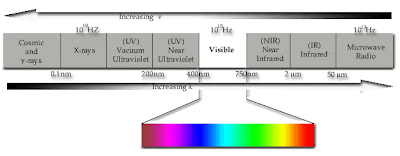 Far infrared is used in thermal imaging cameras. Heat given off by objects is in the far infrared spectrum of light.
  The pictures i would be taking would not show this kind of thermal imaging, just the light from the Near Infrared.
Simply put, i wanted to remove the piece of glass that blocks infrared light, then add exposed film which ONLY allows infrared light into the camera.First, the hard part. Camera's have a tiny piece of glass between the lens and the sensor which blocks infrared light from passing through. I wasn't sure i would be able to remove it but i did. It's the broken pieces of red tinted glass at the bottom right. And even more surprising is that i was able to put the camera back together the first time and it still worked.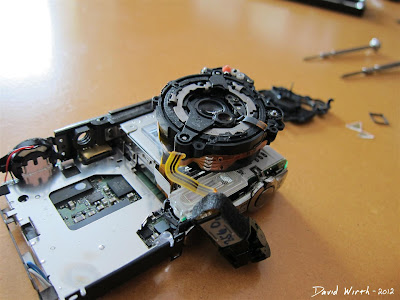
Now that infrared light can pass to the camera's sensor i needed a way to block the visible light. Online there was a lot of different ways that people said this could be done but the cheapest and easiest way looked to use a piece of film negative and an old floppy disc. And i tried part of an old floppy disc.
 Here are the pieces from the exposed and unexposed processed film.
 I was planning on mounting the film on a PVC filter like i had done before. In hindsight that probably would have been a good idea. So i started to making a fitting out of PVC like before. But then i saw that the best way to do it was to cut the film and glue it in place INSIDE of the camera, right in front of the sensor. So i ended up not using this.
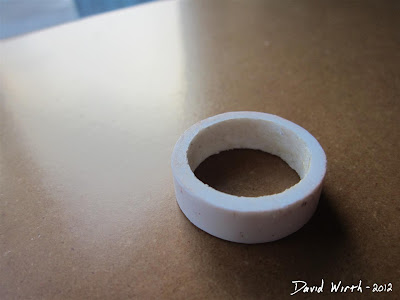 But before i did that i needed to know what is the best material to use. I decided to experiment with all of the ways people suggested to block the visible light. Here were the 3 pieces that i would be testing.
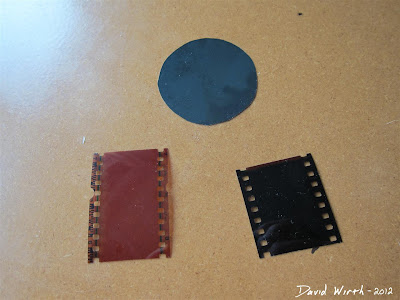 The material and the results from the test: (click images to enlarge)1. Film negative that had been exposed to light
 2. Film negative that had not been exposed to light
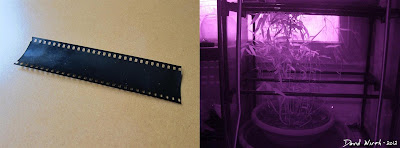 3. Floppy discThe floppy disc over the lens made the picture come out so dark that it wasn't usable. I could have left the shutter open for a much longer time, similar to the ND filter, but i decided just not to use it. So i moved on to layering two pieces of material together.5. Two pieces of film negative that had been exposed to light
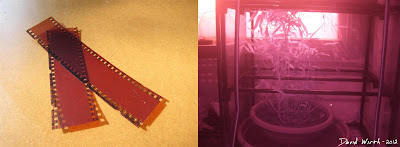 6. 2 pieces of film negative that had not been exposed to light
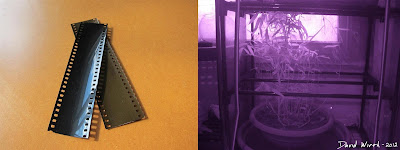 7. 1 piece of exposed and 1 piece of unexposed film negative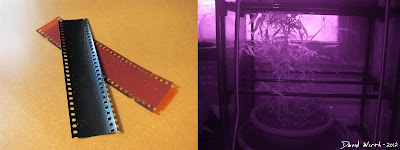
It turned out that the best result was the last one i tested, 1 piece of exposed and 1 piece of unexposed film negative.I took a couple of pictures in the backyard and liked how they came out. This picture is the original, right out of the camera. This is after adjusting the colors in Photoshop.
 Now here's the bad part. When i finally decided what to use i took the camera apart again and glued in the 2 pieces over the sensor.

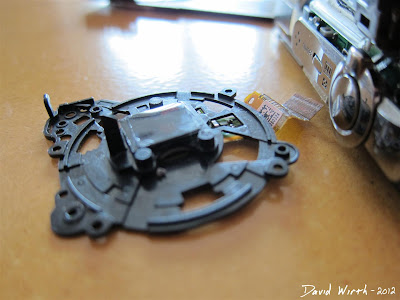 Then when trying to put the camera back for the 4th time i damaged the small ribbon cable from the lens to the circuit board. You can kind of see the tiny hole in the orange cable.
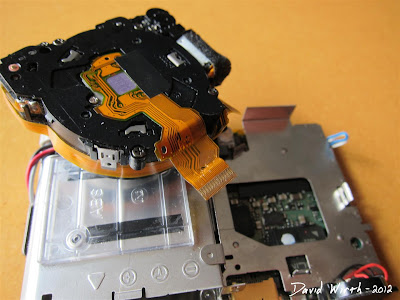 It's a bit of a bummer, not that i would have used this camera a lot but it would have been fun to experiment with.
|
camera,
film negative,
glass,
heat,
infrared filter,
IR filter,
lens sensor,
light,
near infrared,
Photography,
Photoshop,
point and shoot,
spectrum,
testing,
visible light,
wavelength
|
Read More...

Well i know now what it takes to get them to grow. Abnormally warm Michigan weather. It's been very warm, it was even 90 degrees here for several days and the plants grew great.
 |
| Add caption |
The best thing about having them outside is that the pads don't dry up and turn brown. Growing them outside is definitely the way to go. High heat/humidity and lots of sun. The water in the buckets got up to 80 degrees. 
First though, let me go back. I originally learned about the American Lotus when working at the CE Power Plant in Monroe Michigan a year ago. 
It has a bay next to the plant, which is part of Lake Erie.  The seeds were everywhere, i picked up a few over the course of 3 days.

This is what the bay looked like last year sometime around July or August. You can see the huge lotus bed.
Early this year. It's foggy there a lot. 
A month and a half ago, still no signs of the lotus, but by now they are probably visible. The nets are used to stop plants and dead fish from getting into the turbines.
While i was there last year i saw some weird seed pods and grabbed a couple of seeds that had washed up. I tried growing the plant indoors during the winter, but it didn't go well. Here's what i've learned about trying to grow a lotus, inside, in Michigan, during the winter:
1. High heat - keep between 70-80 degrees, if it's too cold it slows down their growing. Heater, light. Not only for growing but also for starting the seed.
2. High humidity - don't let the leaf dry out once it reaches the surface, for me that meant covering the bowl with Saran wrap.
3. Let the roots start before planting in the mud - i noticed that if i put the seed and stem in the mud too early that the roots never started growing. But if i let the plant grow in a bowl of water the roots started fine. Then i was able to carefully transfer it to the mud.
4. Change the water frequently - i'm not sure if it's bacteria or algae but a white scum develops in the water during the first stages of growing.
Here's what i saw when i finally figured all of that out. If i planted the seed too early it would die. But if i waited till the roots grew an inch or two then planted it in mud it did ok. 
I even checked the PH of the water. It's suppose to be between 6 and 8.

The plant will grow just in a bowl of water for several weeks. There's enough energy in the seed for it to develop roots and put up around 4 lilypads.  These were grown in just water.

This is what it looked like in March earlier this year. It was still too cold for the plants to start coming up. Although i could get them to start growing, they would turn brown and soon die. 
Early this spring, on the way to the CE plant i got off I-75 at exit 11. There's another power plant on Lake Erie where the lotus plant grows right near the road. You can see last years stems in the water.

I already commented on what i thought about the lotus being protected here in Michigan. In Missouri, Rhode Island and other states it's a nuisance species, you can get fined for planting it. Here in Michigan it's protected, you get fined for taking it out. That's dumb.

Anyway, i found it very difficult to grow them inside during the winter. But since it warmed up and i moved the buckets outside they are doing way better. Outside now there is high humidity and high heat, the two things i was having problems with inside. I'll know by the end of summer how well they grew.
|
bowl,
days,
degrees,
die,
Dixie Cup plant water tower,
heat,
humidity,
Lake Erie,
lotus,
michigan,
Monroe,
nuisance species,
PH,
power plant,
protected,
roots,
seeds,
sun,
warm
|
Read More...




 Home
Home


